
What to expect at your evaluation
You do not need to arrive knowing whether you want DBS or focused ultrasound, and attending commits you to nothing. The purpose of the visit is to establish what is happening and what your realistic options are.
Before the visit
What to bring or send ahead
A complete medication list
Names, doses and timing, including medications you have stopped and why. Knowing what has already been tried at an adequate dose is among the most important information in the room.
Prior imaging and records
Any MRI or CT of the brain — the images themselves rather than only the report — along with clinic notes and results of previous testing. Studies done elsewhere can be uploaded ahead of the visit.
Someone who knows you well
A partner, adult child or friend often notices changes patients have stopped noticing, and remembers what was discussed afterward.
A short video, if you have one
Symptoms are not always at their most typical in a clinic room. A brief phone video — pouring a drink, writing, at the end of a medication cycle — is genuinely useful.
Before the visit
Uploading imaging and records
Outside scans and medical records both reach us the same way — through RUSH's secure Ambra portal. Sending them ahead is optional, and it is what lets the team review your case properly before you are in the room.
MRI or CT images
- Open the secure upload portal.
- Enter your email address. If you have used Ambra before you will be asked to sign in; if not, you create an account.
- Choose Upload Imaging.
- Put the disc from the imaging center into your computer, if that is where your study is.
- Select the correct drive or the imaging files.
- Confirm the upload.
We need the images themselves, not only the radiologist's report. If the study was done at a hospital already on the Chicago-area Ambra network, its radiology department can send it straight to RUSH instead — ask them to. A disc mailed to the program works too.
Clinic notes and records
- Open the secure upload portal.
- Gather the records into PDFs where you can. Phone photographs of paper records are fine.
- Choose Upload Files/Documents rather than imaging — records go up as ordinary files.
- Upload everything you have.
- Email neurofus@rush.edu with the subject Patient Records Uploaded, and include your name, the date you uploaded and a line on what you sent.
That last email is what lets the team match your documents to the right chart, so it is worth the minute it takes.
Please do not email records or images to us unprompted
Ordinary email is not a secure channel for health information, which is exactly what the upload portal and MyChart exist to solve. If something will not upload, call the coordinators on (312) 563-2032 rather than attaching it to an email.
During the visit
How the appointment runs
-
1
Your history, in your words
When symptoms began, how they have changed, what distinguishes a bad day from a good one, and how closely that pattern tracks your medication schedule.
-
2
Examination
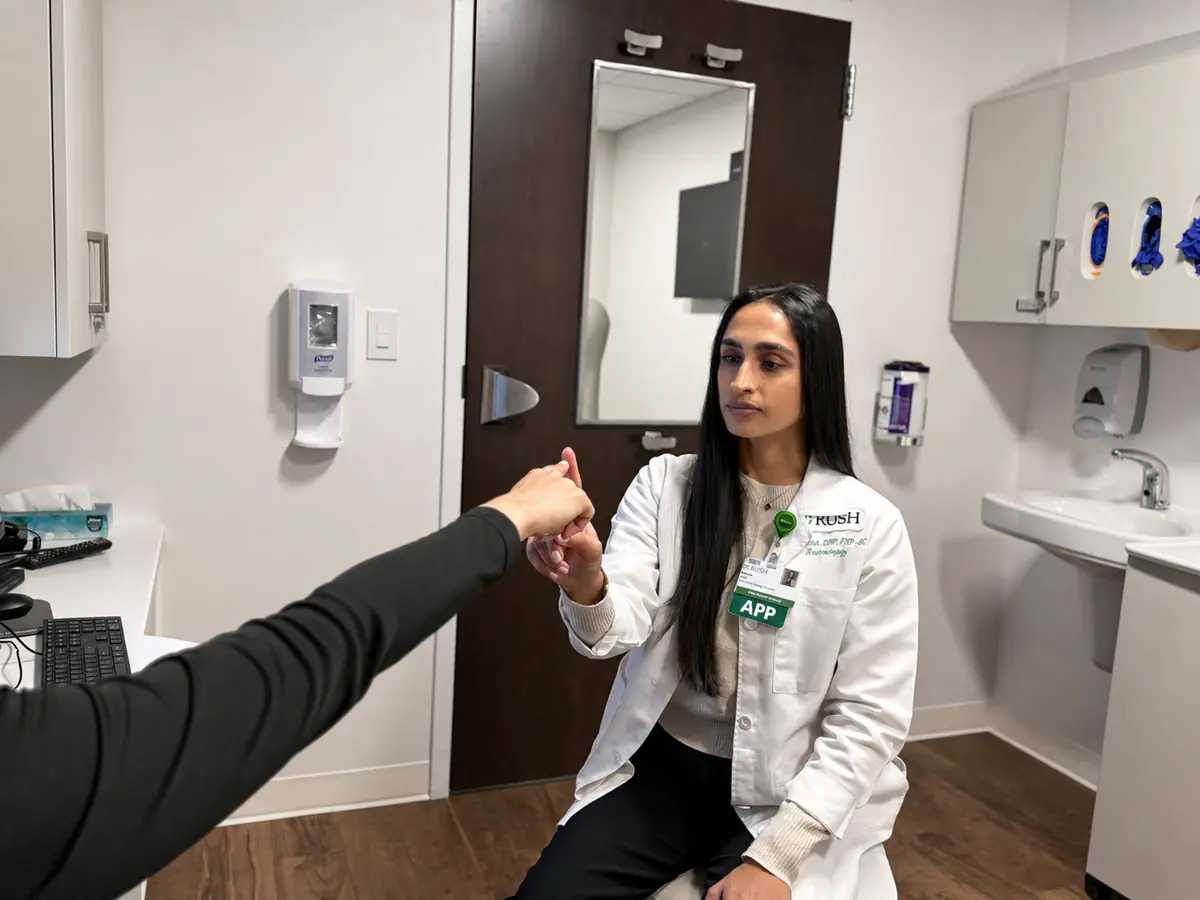
A movement disorders examination, often including writing, drawing spirals, holding a posture and walking. It is sometimes performed both on and off medication, because the difference between the two is itself diagnostic information.
-
3
What you would most like back
Neuromodulation is effective for specific symptoms and not for others, so a clear answer here guides the recommendation more than any single test result.
-
4
Options, and a written plan
What medication still has to offer, whether DBS or focused ultrasound is worth pursuing, and what each would realistically change. If neither is right for you yet, you will be told so directly. You leave with the next steps in writing and a coordinator's direct contact. Compare the two treatments →
After the visit
What usually happens next
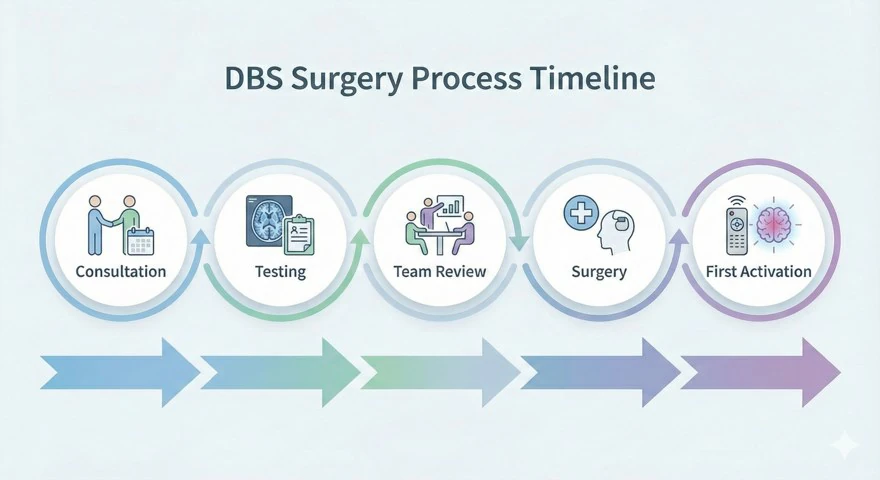
If an advanced therapy is worth exploring, testing follows over the next few weeks. For DBS candidates with Parkinson's disease this typically means a levodopa challenge, high-resolution MRI and formal neuropsychological testing. For focused ultrasound it includes a CT of the skull to calculate the skull density ratio.
Your case is then reviewed by the full team — neurology, neurosurgery, neuropsychology, advanced practice and coordination — before a recommendation is made.
Second opinions are welcome and common, as is deciding to wait. Neither closes any door.
The full care journey →
Insurance and coverage →
Plan your visit →
Book your evaluation
No referral is required, and many patients start with a video visit rather than traveling.