
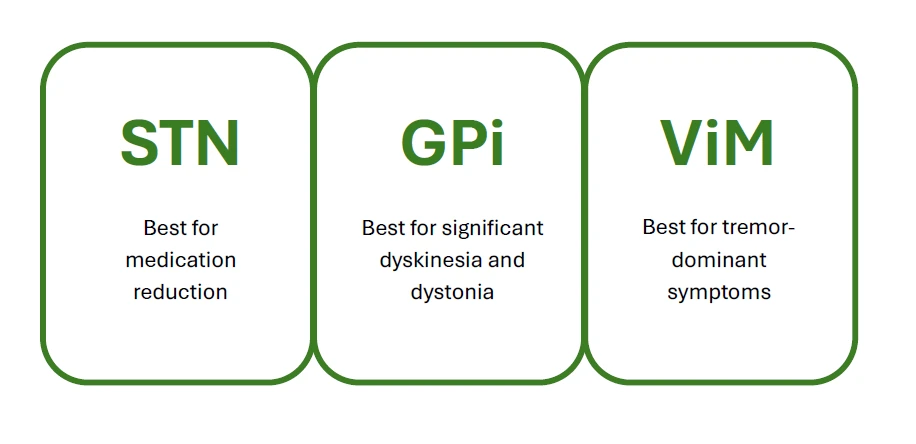
Which target is chosen matters as much as the decision to operate. Different targets relieve different symptoms, and choosing between them is one of the main tasks of the evaluation.
Parkinson's disease
DBS is considered the standard of care for advanced Parkinson's disease. It becomes most useful once medication stops being predictable — when the day swings between periods of good control and periods when symptoms return, or when the doses required for control begin producing dyskinesia.
Stimulation of the subthalamic nucleus (STN) or the globus pallidus internus (GPi) can extend good "on" time, reduce tremor, rigidity and slowness, and in many patients allow a meaningful reduction in medication.
A useful rule of thumb: symptoms that respond to levodopa generally respond to DBS. Tremor is the exception, often improving with DBS even when medication never controlled it well. Symptoms that do not respond to levodopa — most balance and gait problems arising late in the disease, and cognitive change — generally do not improve with stimulation either.
More about Parkinson's disease care →
Essential tremor
Essential tremor produces an action tremor: it appears when the hands are used — writing, drinking, holding a utensil — rather than at rest. DBS is particularly effective here, including in patients for whom medication has failed entirely.
It is especially valuable when tremor affects both hands, or involves the head or voice, because both sides can be treated and settings balanced between them. It also preserves flexibility if symptoms change.
More about essential tremor care → · Compare DBS with focused ultrasound →
Dystonia
Dystonia produces sustained, involuntary contractions that twist the body into abnormal postures, and it can be painful. It may be focal — cervical dystonia affecting the neck is the most familiar form — or generalized.
Botulinum toxin injections and medication come first and are often highly effective for focal dystonia. When symptoms remain disabling despite them, pallidal (GPi) DBS is an established therapy supported by the literature for medically refractory disease.
Dystonia behaves differently from tremor after surgery. Improvement develops gradually over weeks to months rather than immediately, and posture often continues to improve for a year or more. Patients who understand this in advance are considerably more comfortable with the pace of change.
Selected other indications
DBS is an established option for a small, carefully selected group of patients with severe, treatment-resistant obsessive-compulsive disorder, and is used in epilepsy neuromodulation. DBS for depression and for Tourette syndrome is approached case by case and, for depression, remains investigational. These evaluations are led jointly with psychiatry.
Complex and mixed tremor syndromes — dystonic tremor, tremor after stroke or traumatic brain injury, tremor associated with multiple sclerosis — are assessed individually. The question is not simply whether tremor is present, but whether reducing it would meaningfully improve function without worsening speech, coordination or balance.
Other conditions we evaluate → · Who is a candidate for DBS →
What DBS does not treat
Being clear about this is part of an honest evaluation. DBS does not improve ataxia — the uncoordinated, wide-based unsteadiness caused by cerebellar disease — because that arises in circuits stimulation does not reach. It does not reverse cognitive decline, and it does not stop the underlying condition from progressing.
What it does is remove a large part of the daily disability produced by the symptoms it treats, which for most patients is what has been taking their independence.