MRI-guided Focused Ultrasound, often called MRgFUS or simply focused ultrasound, is an incisionless neurosurgical treatment used to treat selected movement disorder symptoms, most commonly disabling tremor. It combines two powerful technologies: high-intensity focused ultrasound, which can deliver energy deep into the brain without an incision, and MRI guidance, which allows the treatment team to see the brain target and monitor temperature changes in real time. The result is a highly precise treatment that can calm abnormal movement circuits without opening the skull, implanting hardware, or leaving a device behind.
How focused ultrasound developed
Focused ultrasound grew out of decades of scientific development. Ultrasound energy has been studied for medical use since the early 20th century, but early brain applications were limited because the skull distorted the ultrasound beams and because physicians could not yet see or measure the treatment effect in real time. The major breakthrough came when advanced MRI, MRI thermometry, and phased-array ultrasound transducers were combined. MRI made it possible to target the brain with exquisite anatomical detail, MRI thermometry allowed the team to watch temperature rise at the target during treatment, and helmet-like transducers with more than a thousand ultrasound elements made it possible to focus energy through the intact skull.
How the treatment works
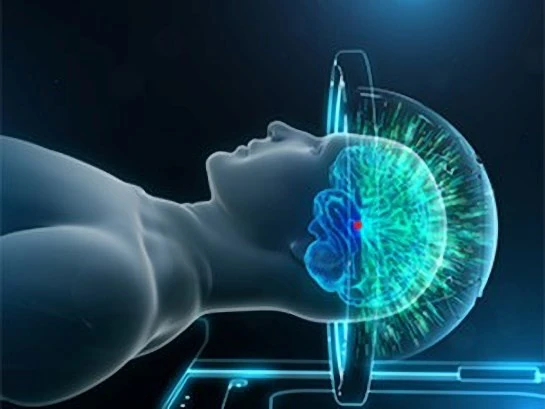
The easiest way to understand MRgFUS is to imagine many low-energy ultrasound beams passing safely through the scalp and skull from different directions. By themselves, each beam is too weak to affect tissue. But where all the beams meet, the energy adds together and creates a small, controlled area of heat. That heat forms a tiny lesion—an intentional, precisely placed change in brain tissue—within a specific motor circuit. For tremor, the most common target is the ventral intermediate nucleus of the thalamus, or VIM, a relay station involved in tremor signaling. By interrupting that abnormal signal, tremor in the opposite hand can often improve immediately.
Inside the MRI scanner
This treatment is performed inside an MRI scanner. The patient is awake, allowing the team to test tremor response during the procedure. Patients may be asked to draw spirals, hold a cup, tap fingers, or perform other simple tasks while the treatment is gradually adjusted. This real-time feedback is one of the defining features of focused ultrasound. It allows the team to see not only where the treatment is being delivered, but also whether it is helping the symptom that matters most.
What it treats, and what is FDA approved
Focused ultrasound is most established for medication-refractory essential tremor and tremor-dominant Parkinson’s disease. The FDA approved MR-guided focused ultrasound thalamotomy for essential tremor in 2016, and approval later expanded to tremor-dominant Parkinson’s disease in 2018. In 2021, FDA approval expanded further to unilateral pallidotomy for selected patients with advanced Parkinson’s disease with medication-refractory motor complications, and in 2025 the FDA cleared staged pallidothalamic tractotomy for selected Parkinson’s patients with medication-refractory motor complications.
What the evidence shows
The clinical evidence for focused ultrasound in essential tremor is strong. A pivotal randomized trial published in The New England Journal of Medicine showed that MRI-guided focused ultrasound thalamotomy reduced hand tremor and improved disability and quality of life compared with a sham procedure, though sensory and gait-related side effects were also reported. Longer-term studies have shown that tremor improvement can remain durable for years in appropriately selected patients, with 5-year follow-up studies reporting sustained improvement in treated-hand tremor and quality-of-life measures.
How it differs from DBS
Focused ultrasound is different from Deep Brain Stimulation in several important ways. DBS uses implanted hardware and adjustable electrical stimulation; focused ultrasound creates a permanent lesion without an implant. There is no battery, no implanted wire, no programming, and no device maintenance. This simplicity is one of its major advantages, particularly for patients who prefer an incisionless, hardware-free treatment or who may not be ideal candidates for implanted devices. At the same time, because the treatment creates a permanent change, patient selection and target selection are extremely important. Unlike DBS, the effect cannot be reprogrammed after the fact.
For many patients, the appeal of focused ultrasound is that it offers meaningful symptom relief with a much lighter physical footprint than traditional surgery. There is no incision, no stitches, and most patients go home the same day. The improvement can be visible during the procedure itself, which can be an emotional moment for patients who have lived with tremor for years. Still, it is important to be clear: focused ultrasound is not a cure for essential tremor or Parkinson’s disease. It treats specific symptoms by targeting specific circuits. The underlying condition may continue to evolve over time.
Our approach at RUSH
At RUSH, focused ultrasound is approached with the same principles that guide all advanced neuromodulation care: accurate diagnosis, careful patient selection, precise targeting, and realistic expectations. The goal is not simply to offer the newest technology. The goal is to match the right treatment to the right patient, using the experience of a multidisciplinary team that understands tremor, Parkinson’s disease, surgical targeting, and long-term outcomes.