
Medication-Refractory Tremor Syndromes
Some patients have disabling tremor that does not fit neatly into essential tremor or Parkinson’s disease. This may include dystonic tremor, Holmes/rubral tremor, tremor related to stroke, multiple sclerosis, traumatic brain injury, Fragile X–associated tremor/ataxia syndrome, or mixed tremor syndromes. These tremors can be complex because the shaking may occur alongside weakness, incoordination, dystonia, imbalance, or other neurological symptoms.
At RUSH, these cases can be evaluated individually to determine whether the tremor is arising from a circuit that may respond to DBS or, in select cases, focused ultrasound. The key question is not simply whether tremor is present, but whether reducing the tremor would meaningfully improve function without worsening other symptoms such as speech, coordination, or balance.
Tardive Dyskinesia / Tardive Dystonia
Tardive syndromes are involuntary movement disorders that can occur after exposure to dopamine-blocking medications, including some antipsychotic or anti-nausea medications. Symptoms may include repetitive mouth, tongue, facial, trunk, or limb movements, or sustained twisting postures consistent with tardive dystonia. In severe cases, these movements can be painful, socially disabling, and resistant to medication.
For carefully selected patients with severe, medication-refractory tardive dystonia or dyskinesia, DBS—most commonly targeting the globus pallidus internus—has been reported to produce meaningful improvement. A systematic review of 117 patients found average improvements of about 62% on AIMS and 76% on BFMDRS in reported cases, though the evidence remains mostly from non-randomized studies.
Mixed Movement Disorder Syndromes
Some patients present with overlapping symptoms—tremor, dystonia, parkinsonism, dyskinesia, chorea, or ataxia—rather than a single, clear diagnosis. These “mixed” syndromes require especially careful evaluation because neuromodulation may improve one symptom while leaving others unchanged, or rarely worsening balance, speech, or coordination.
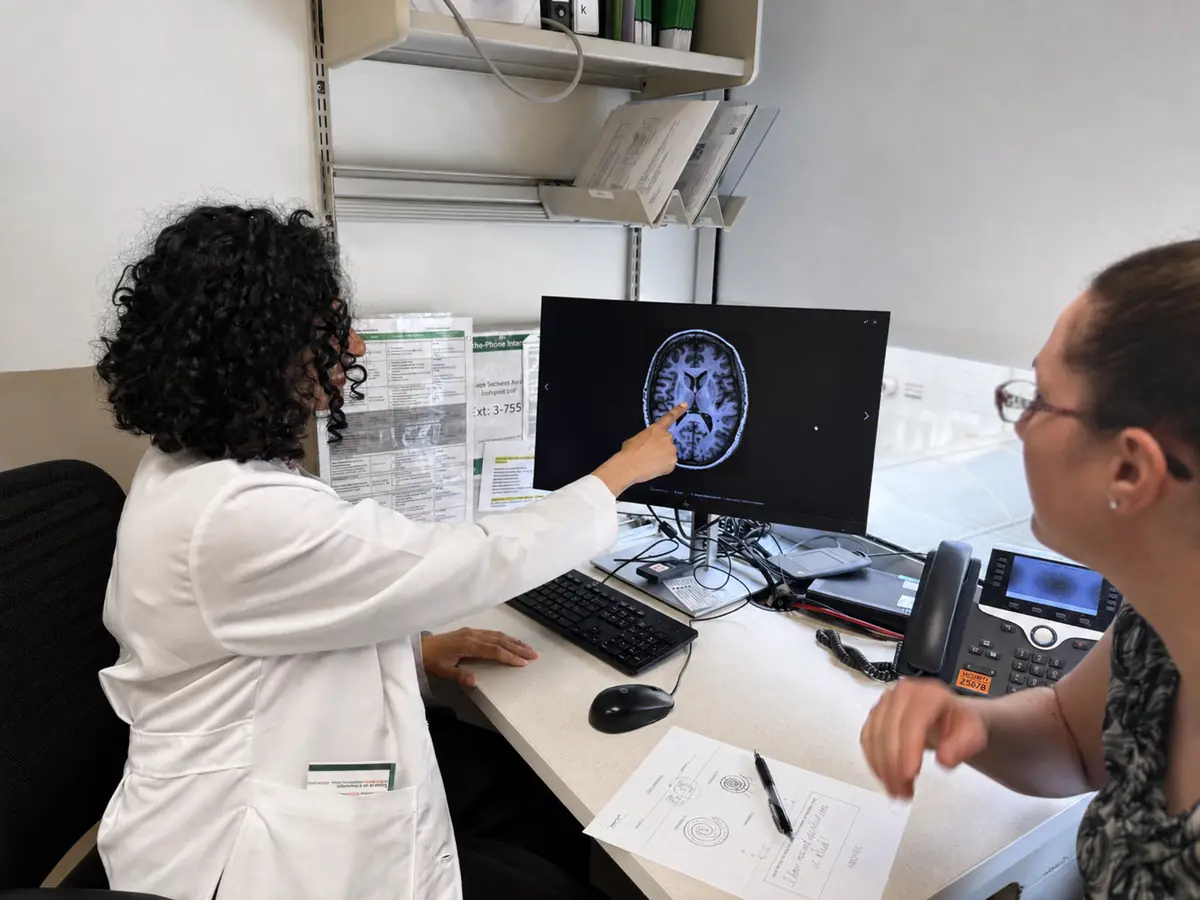
At RUSH, mixed syndromes are best approached through multidisciplinary evaluation. The goal is to identify the most disabling symptom, determine whether it maps to a treatable brain circuit, and decide whether DBS or FUS would offer a meaningful functional benefit.
Craniofacial Dystonia / Meige Syndrome
Craniofacial dystonia, including Meige syndrome, affects muscles of the face, eyelids, jaw, mouth, and sometimes the neck. Patients may experience forceful blinking, jaw opening or closing, grimacing, tongue movements, or speech and swallowing difficulty. These symptoms can be socially distressing and functionally limiting.
Botulinum toxin injections are often first-line treatment, but some patients remain severely affected. DBS has been studied for refractory Meige syndrome, most commonly using GPi or STN targets. A 2025 individual-patient meta-analysis evaluated DBS outcomes for Meige syndrome and compared GPi and STN approaches, reflecting growing but still specialized evidence for selected severe cases.
Cervical Dystonia
Cervical dystonia causes involuntary contraction of neck muscles, often pulling the head into abnormal positions or causing tremulous neck movements. It can be painful, exhausting, and socially limiting. Many patients respond well to botulinum toxin injections, but some have incomplete benefit, dose-limiting side effects, or complex patterns that are difficult to treat adequately with injections alone.
For severe, refractory cervical dystonia, DBS may be considered on a case-by-case basis. Large reviews of DBS for dystonia support its role in drug-refractory dystonia, with outcomes influenced by dystonia type, distribution, cause, and duration of symptoms.
Myoclonus-Dystonia
Myoclonus-dystonia is a rare movement disorder characterized by quick jerking movements, often combined with dystonia. It may begin in childhood or adolescence and can be genetic, including SGCE/DYT11-related disease. Symptoms may affect the arms, neck, trunk, and voice, and can interfere with writing, eating, walking, and social confidence.
DBS, most often targeting the GPi, has been reported to help selected patients with myoclonus-dystonia, particularly monogenic non-degenerative dystonias such as SGCE/DYT11. The evidence suggests that these patients can respond favorably, but evaluation must be individualized and should include genetic, neurological, and functional assessment.
Huntington’s Disease Chorea
Huntington’s disease is a genetic neurodegenerative condition that can cause chorea—irregular, flowing, involuntary movements—along with cognitive, psychiatric, and behavioral symptoms. Chorea can become severe enough to interfere with walking, eating, speaking, sleep, and safety.
DBS has been explored in selected cases of severe, medication-refractory Huntington’s chorea, usually targeting the pallidum. However, this remains a specialized and non-routine application because Huntington’s disease affects multiple brain systems and progresses over time. Recent literature suggests pallidal DBS may reduce chorea in selected patients, but careful counseling is essential because DBS does not treat the underlying disease or cognitive/psychiatric progression.
Ataxia with Tremor
Ataxia refers to impaired coordination, often causing clumsy movement, imbalance, slurred speech, and difficulty with precise hand control. Some patients with ataxia also have tremor. This combination is challenging because the visible shaking may not be the only problem; the limb may also be poorly coordinated even if tremor is reduced.
In general, ataxia is not a good target for neuromodulation. DBS or FUS may reduce tremor in select patients, but they do not reliably improve the underlying incoordination and may worsen balance or speech in vulnerable patients. At RUSH, patients with ataxia and tremor would require careful case-by-case evaluation, with particular attention to whether tremor reduction would actually improve daily function.
Psychiatric and Behavioral Neuromodulation
Addiction and Substance Use Disorders
Substance use disorders are complex brain and behavioral conditions involving reward, craving, habit formation, impulse control, stress response, and environmental triggers. Standard treatment remains the foundation of care, including medication-assisted treatment when available, psychotherapy, recovery programs, social support, and psychiatric care. However, relapse rates remain high for many patients, and neuromodulation is being studied as a possible adjunct for severe, refractory cases.
Both DBS and focused ultrasound have been explored in addiction research, often targeting reward circuitry such as the nucleus accumbens. A 2024 systematic review highlighted growing interest in DBS for substance use disorders, though the field remains investigational. Early focused ultrasound data are also promising: a 2023 pilot trial of low-intensity focused ultrasound targeting the bilateral nucleus accumbens in four participants with substance use disorder found the procedure was safe and well tolerated, with no MRI structural changes and reductions in cue-induced craving during follow-up. Larger controlled studies are still needed before this can be considered established therapy.
Anorexia Nervosa and Severe Eating Disorders
Anorexia nervosa is a severe psychiatric illness involving restrictive eating, distorted body image, intense fear of weight gain, medical frailty, and high psychiatric burden. Most patients are treated with multidisciplinary psychiatric, nutritional, medical, and behavioral care. In a small subset of severe, chronic, treatment-refractory cases, neuromodulation has been studied as an investigational approach.
DBS has been explored in severe refractory anorexia nervosa, with targets including reward, mood, and anxiety-related circuits. A 2022 systematic review and meta-analysis found that DBS has been studied in pioneering small trials, but overall effects remain uncertain and the evidence base is still limited. A 2023 patient-level systematic review similarly reflects ongoing interest, but this remains highly specialized and should be considered only in exceptional cases within expert multidisciplinary care.
Cluster Headache
Cluster headache is a severe primary headache disorder marked by repeated attacks of intense one-sided pain, often around the eye or temple, with tearing, nasal congestion, agitation, or other autonomic symptoms. It is sometimes called one of the most painful headache disorders and can be devastating when chronic and refractory.
Neuromodulation has been used in severe refractory cluster headache, including peripheral approaches such as occipital nerve stimulation and sphenopalatine ganglion stimulation, as well as DBS in highly selected cases. DBS studies have most often targeted posterior hypothalamic or related deep brain regions. Systematic reviews suggest DBS may help some patients with otherwise intractable chronic cluster headache, but this remains a specialized treatment reserved for extreme refractory cases after standard medical and less invasive therapies have failed.