
MRI-guided Focused Ultrasound is a rapidly evolving treatment platform in neurosurgery and neuromodulation. Although it is most widely known for treating tremor, the field has expanded significantly over the past decade, with growing FDA approvals, ongoing clinical trials, and increasing experience treating a broader range of neurologic conditions. At its core, focused ultrasound works by precisely targeting specific brain circuits involved in abnormal movement patterns. The effectiveness of treatment depends not only on the technology itself, but on selecting the correct condition, symptom profile, and brain target for each individual patient.
At present, the strongest and most established evidence for focused ultrasound is in the treatment of essential tremor and selected symptoms of Parkinson’s disease.
Essential Tremor
Essential tremor is the most common movement disorder treated with focused ultrasound and remains the condition with the longest and most robust clinical experience. Patients with essential tremor often develop progressively worsening shaking of the hands, arms, head, or voice that interferes with daily life. Medications such as propranolol or primidone may help initially, but many patients eventually reach a point where tremor continues to disrupt activities despite medication trials or where side effects become limiting.
Focused ultrasound for essential tremor most commonly targets the ventral intermediate nucleus (VIM) of the thalamus, a key relay center in the tremor network. By creating a small, highly precise lesion in this circuit, tremor in the opposite hand can often improve dramatically and sometimes immediately during the procedure itself.
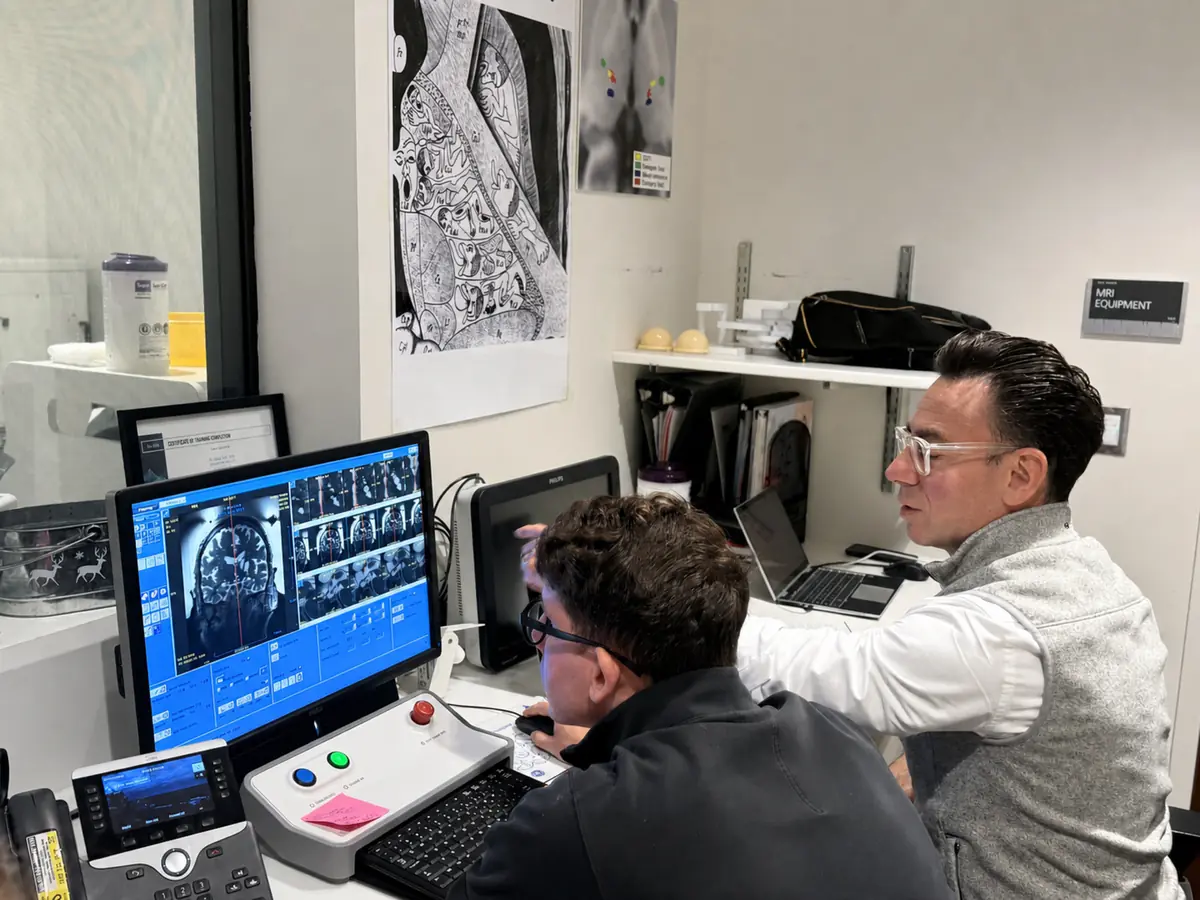
The FDA approved MR-guided focused ultrasound thalamotomy for medication-refractory essential tremor in 2016 following pivotal clinical trials demonstrating significant tremor reduction and improvement in quality of life. Subsequent long-term studies have shown that these benefits can remain durable for years in appropriately selected patients. Focused ultrasound has become an especially attractive option for patients seeking a nonincisional treatment without implanted hardware or ongoing device management.
More recently, the field has evolved to include carefully selected bilateral staged treatment for essential tremor. Historically, lesioning procedures on both sides of the brain raised concerns about speech and balance side effects. However, advances in technique, patient selection, and staged approaches have expanded the ability to treat both sides in selected patients safely and effectively.
Parkinson’s Disease
Focused ultrasound is also FDA-approved for selected symptoms of Parkinson’s disease, particularly tremor-dominant Parkinson’s disease. In some patients, tremor remains severe despite medications and becomes one of the most disabling aspects of the disease. For these individuals, focused ultrasound thalamotomy targeting the VIM can significantly reduce tremor and improve function.
Beyond tremor, focused ultrasound applications in Parkinson’s disease have expanded substantially. In 2021, the FDA approved unilateral pallidotomy using focused ultrasound for selected patients with advanced Parkinson’s disease experiencing medication-refractory motor complications, including dyskinesia and motor fluctuations. This approach targets the globus pallidus internus (GPi), another important motor circuit within the basal ganglia.
Most recently, the FDA approved staged bilateral pallidothalamic tractotomy (PTT) for selected patients with Parkinson’s disease. PTT targets pathways involved in abnormal motor signaling between the pallidum and thalamus and represents another major evolution in incisionless functional neurosurgery. The approval of staged bilateral treatment reflects growing confidence in the safety and precision of modern focused ultrasound techniques when performed at experienced centers with careful patient selection.
These newer Parkinson’s applications are particularly important because they demonstrate that focused ultrasound is no longer limited to tremor alone. The field is moving toward broader circuit-based treatment of Parkinsonian symptoms, with ongoing research exploring additional targets and treatment strategies.
Other Emerging and Investigational Applications
Focused ultrasound is also being studied for a wide range of additional neurologic and psychiatric conditions. These include obsessive-compulsive disorder, depression, epilepsy, neuropathic pain, addiction, Alzheimer’s disease, and brain tumor applications. Some studies involve lesioning approaches, while others use low-intensity ultrasound to temporarily open the blood-brain barrier or modulate neural circuits without creating permanent lesions.
At RUSH, focused ultrasound is approached not simply as a technology, but as part of a broader neuromodulation program. The most important question is not whether focused ultrasound can technically be performed, but whether it is the right treatment for the patient’s specific symptoms, goals, anatomy, and long-term needs. Some patients are better served by focused ultrasound, while others may benefit more from Deep Brain Stimulation or continued medical therapy. Careful evaluation and multidisciplinary discussion remain central to determining the best individualized approach.
As the technology continues to evolve, focused ultrasound is likely to play an increasingly important role in the treatment of movement disorders and neuromodulation more broadly. The expansion of FDA approvals, bilateral treatment strategies, and emerging targets reflects how rapidly the field is advancing—and how much potential still lies ahead.