
Determining who is a good candidate for MRI-guided Focused Ultrasound is one of the most important parts of the treatment process. Focused ultrasound can be remarkably effective for the right patient, but like all neuromodulation therapies, its success depends heavily on accurate diagnosis, appropriate symptom selection, imaging suitability, and realistic expectations. At experienced centers, candidacy is not determined by a single scan or one clinic visit. It is a structured, multidisciplinary evaluation designed to ensure that the treatment being offered matches both the disease and the goals of the individual patient.
Who focused ultrasound is for
In general, focused ultrasound is considered for patients with medication-refractory tremor, meaning tremor that continues to interfere with daily life despite appropriate medication trials or tremor that cannot be adequately treated because medications cause unacceptable side effects. Most commonly, this includes patients with essential tremor or tremor-dominant Parkinson’s disease.
From a patient’s perspective, the point at which focused ultrasound becomes reasonable is often when tremor begins to meaningfully interfere with independence or quality of life. Patients commonly describe difficulty eating, drinking, writing, typing, shaving, applying makeup, buttoning clothing, using tools, or simply feeling comfortable in social situations. Many patients have already adapted their lives around tremor before seeking treatment—avoiding restaurants, using two hands to hold a cup, changing handwriting, or giving up hobbies and activities they once enjoyed.
Confirming the diagnosis
One of the most important parts of evaluation is confirming that the tremor syndrome is one that is known to respond well to focused ultrasound. Not all tremors are the same. Tremor may arise from essential tremor, Parkinson’s disease, dystonia, cerebellar disorders, medication effects, neuropathy, or other neurologic conditions. Some tremor syndromes respond very well to thalamic lesioning, while others do not. Distinguishing between these patterns requires experience and careful neurologic evaluation.
How the evaluation begins
At RUSH, many patients can begin the evaluation process through an initial telemedicine consultation with the treatment team—often directly with the neurosurgeon specializing in focused ultrasound and neuromodulation. This early consultation is designed to simplify and streamline the experience, especially for patients traveling from outside the Chicago area. Rather than navigating multiple layers of referrals before obtaining meaningful information, patients are able to connect directly with a lead specialist who can review symptoms, discuss treatment options, assess potential candidacy, and help determine whether focused ultrasound is likely to be an appropriate next step. For many patients and families, this direct access helps reduce uncertainty and provides a clearer understanding of the process early on.
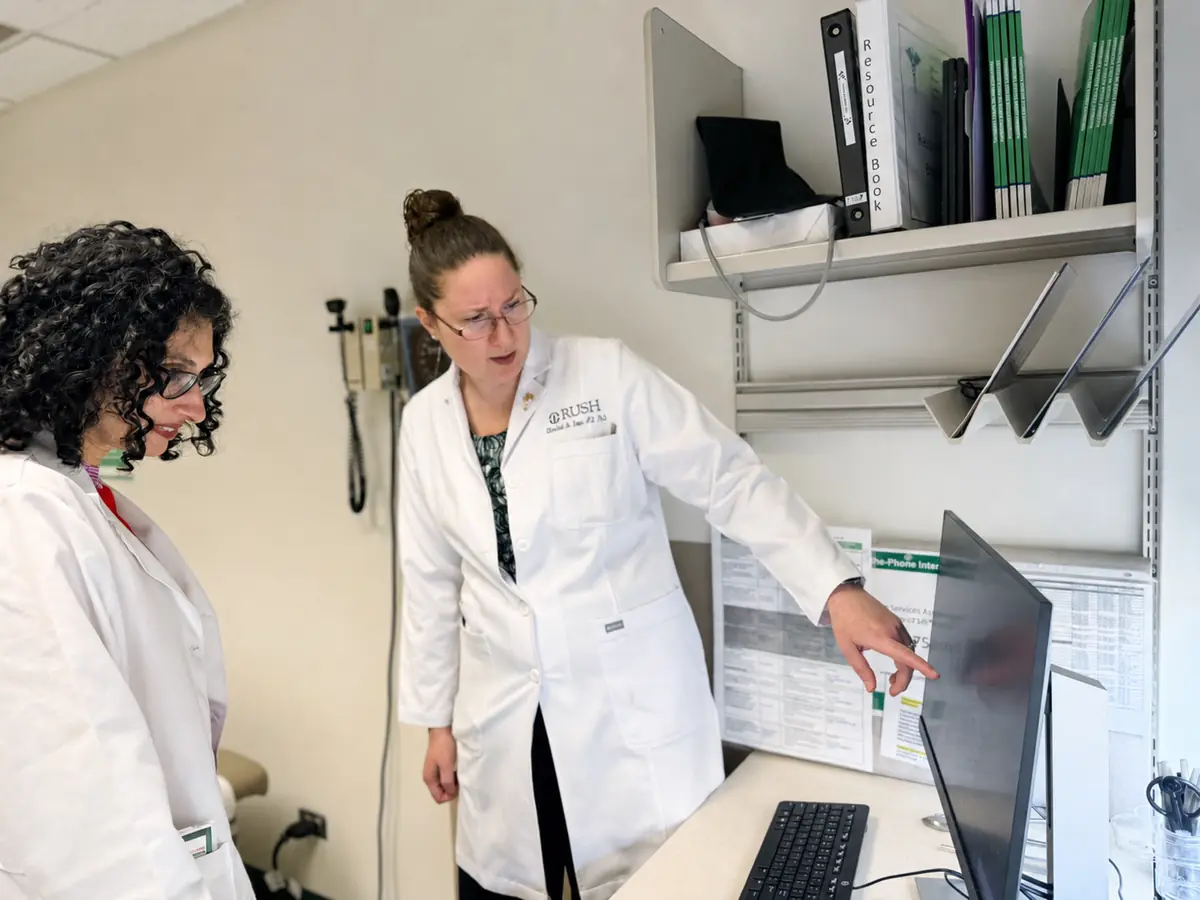
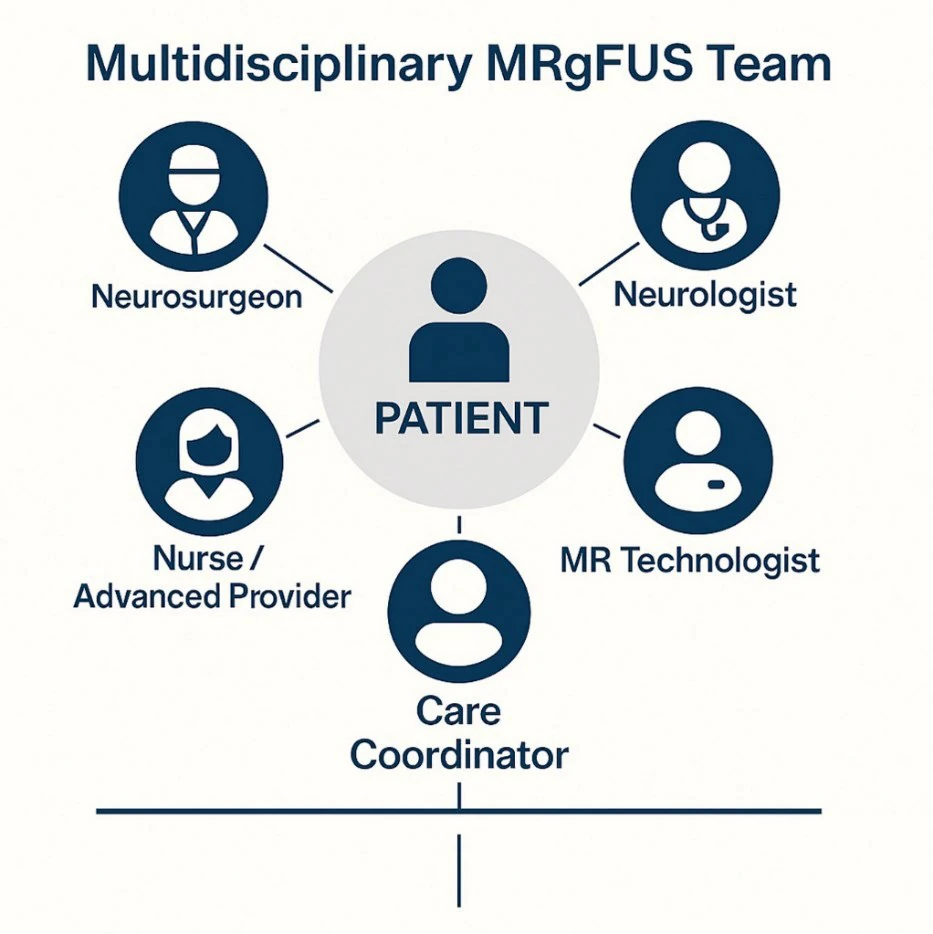
As part of the formal evaluation process, patients also undergo additional specialized assessments, which may include evaluation by a movement disorders neurologist, advanced imaging studies, and other testing depending on the condition being treated and the patient’s individual medical history. The purpose of this multidisciplinary evaluation is to confirm the diagnosis, characterize the tremor or movement disorder phenotype accurately, assess imaging suitability, and ensure that the expected benefits of treatment outweigh the risks.
Reviewing the medications you have tried
A detailed review of medications is also important. In essential tremor, this usually includes assessment of prior trials of medications such as propranolol or primidone. In Parkinson’s disease, the neurologist evaluates the broader symptom profile, medication responsiveness, fluctuations, and the presence of symptoms that are less likely to improve with focused ultrasound.
Imaging and the skull density ratio
Patients also undergo a high-resolution MRI of the brain. This serves several purposes. First, it helps ensure there are no structural abnormalities that would make treatment unsafe. Second, it allows the surgical team to plan the target with precision. Third, it helps assess skull characteristics, which are uniquely important in focused ultrasound.
Unlike DBS, focused ultrasound depends on the ability of ultrasound energy to pass effectively through the skull. Some skulls transmit ultrasound energy more efficiently than others. This is measured using what is called the skull density ratio (SDR), calculated from a CT scan. Patients with very unfavorable skull characteristics may not be able to reach therapeutic temperatures safely or effectively. While low SDR does not automatically exclude treatment, it can influence candidacy and expected treatment efficiency. Published literature has shown that skull characteristics significantly affect energy transmission and treatment success.
Cognitive testing
For selected patients—particularly older individuals or those with concerns about memory or cognition—formal neuropsychological testing may also be recommended. This is not required for every patient, but can help identify factors that influence recovery, expectations, or treatment choice.
Weighing focused ultrasound against DBS
An important part of candidacy discussion involves understanding the differences between focused ultrasound and DBS. Focused ultrasound creates a permanent lesion and does not involve implanted hardware or future programming. Many patients are drawn to its incisionless nature and the convenience of minimal long-term maintenance. However, because the treatment is not adjustable after it is completed, careful target selection and expectation setting are critical. DBS may be preferable in patients who need bilateral treatment, long-term adjustability, or broader symptom control.
For essential tremor, focused ultrasound is especially attractive for patients with severe dominant-hand tremor who prefer a non-implant option or who may not want or medically tolerate DBS surgery. For tremor-dominant Parkinson’s disease, focused ultrasound may be appropriate for carefully selected patients whose most disabling symptom is tremor, particularly when tremor remains difficult to control despite medication.
Indications beyond tremor
The FDA has also expanded focused ultrasound indications beyond tremor alone, including selected Parkinson’s-related motor symptoms through pallidotomy-based approaches. These applications remain more nuanced and require particularly careful evaluation at experienced centers.
How the decision is made
As with DBS, candidacy decisions at RUSH are not made by one person in isolation. Imaging, neurologic evaluation, symptom profile, medical history, goals, and expectations are all reviewed carefully before treatment is recommended. The purpose of this process is not to create barriers—it is to maximize the likelihood that treatment will provide meaningful benefit safely and predictably.
Ultimately, the best candidates for focused ultrasound are patients whose symptoms clearly match the strengths of the therapy, whose anatomy is favorable, and whose goals align with what the treatment is realistically designed to achieve.