
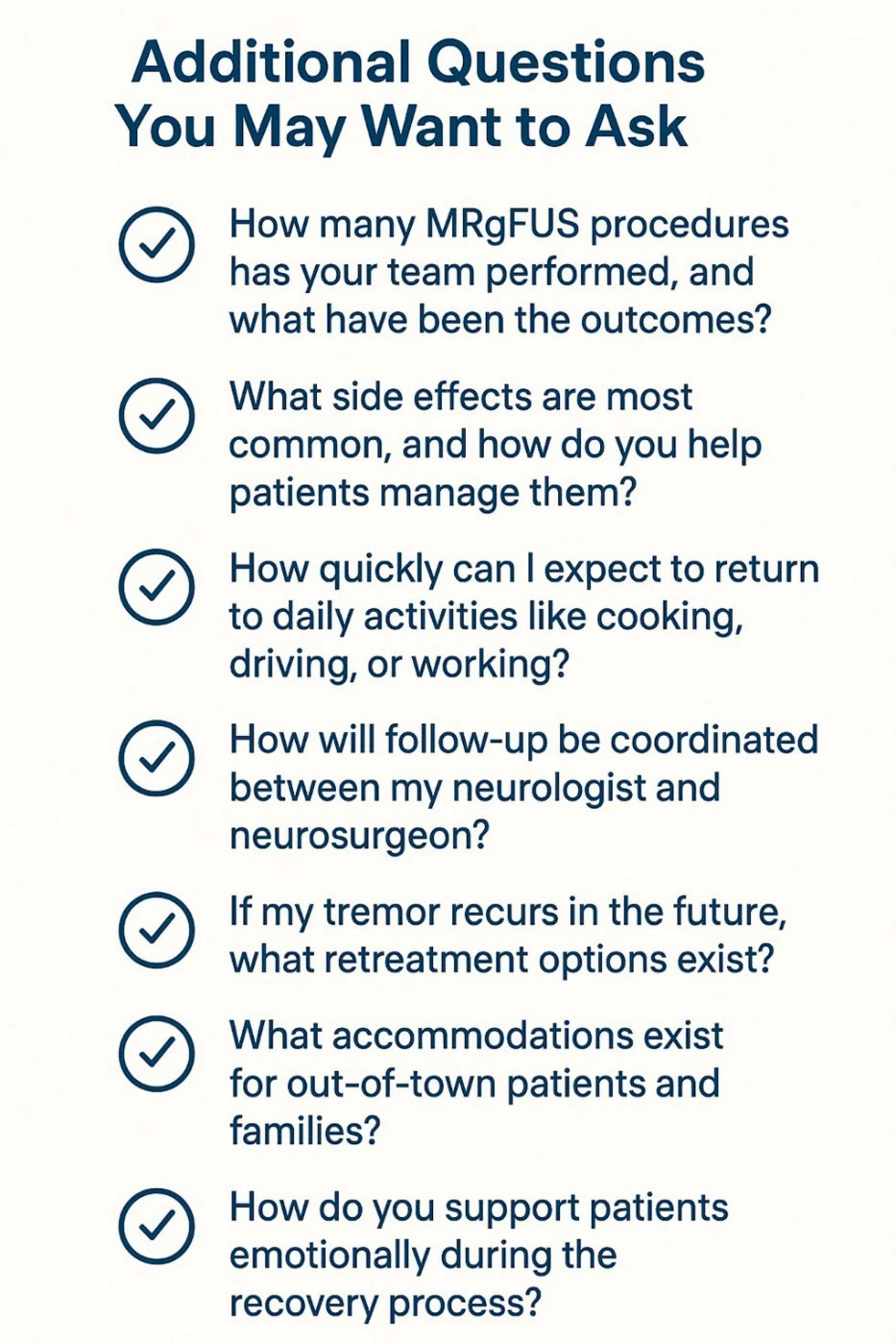
Patients considering focused ultrasound often have many questions about how the treatment works, what recovery is like, and how it compares with other treatment options such as Deep Brain Stimulation. The following are some of the most common questions asked by patients and families during the evaluation process.
MRI-guided Focused Ultrasound is an incisionless neurosurgical treatment that uses highly focused sound waves to create a precise lesion within a specific brain circuit involved in tremor or other movement symptoms. MRI guidance allows the treatment team to visualize the target and monitor temperature changes in real time during the procedure.
Yes, although it is very different from traditional surgery. Focused ultrasound treats the brain without incisions, implanted hardware, or opening the skull. Even though there is no cutting, it is still a highly precise neurosurgical procedure and should be approached with the same level of care and expertise.
Focused ultrasound is FDA-approved for:
-
medication-refractory essential tremor,
-
tremor-dominant Parkinson’s disease,
-
and selected Parkinson’s disease motor complications using pallidal targets.
The field continues to evolve rapidly, with ongoing research into additional neurologic and psychiatric applications.
Many patients notice tremor improvement during the procedure itself. Because patients are awake during treatment, the team can test tremor repeatedly throughout the process. For some individuals, the change can feel immediate and dramatic.
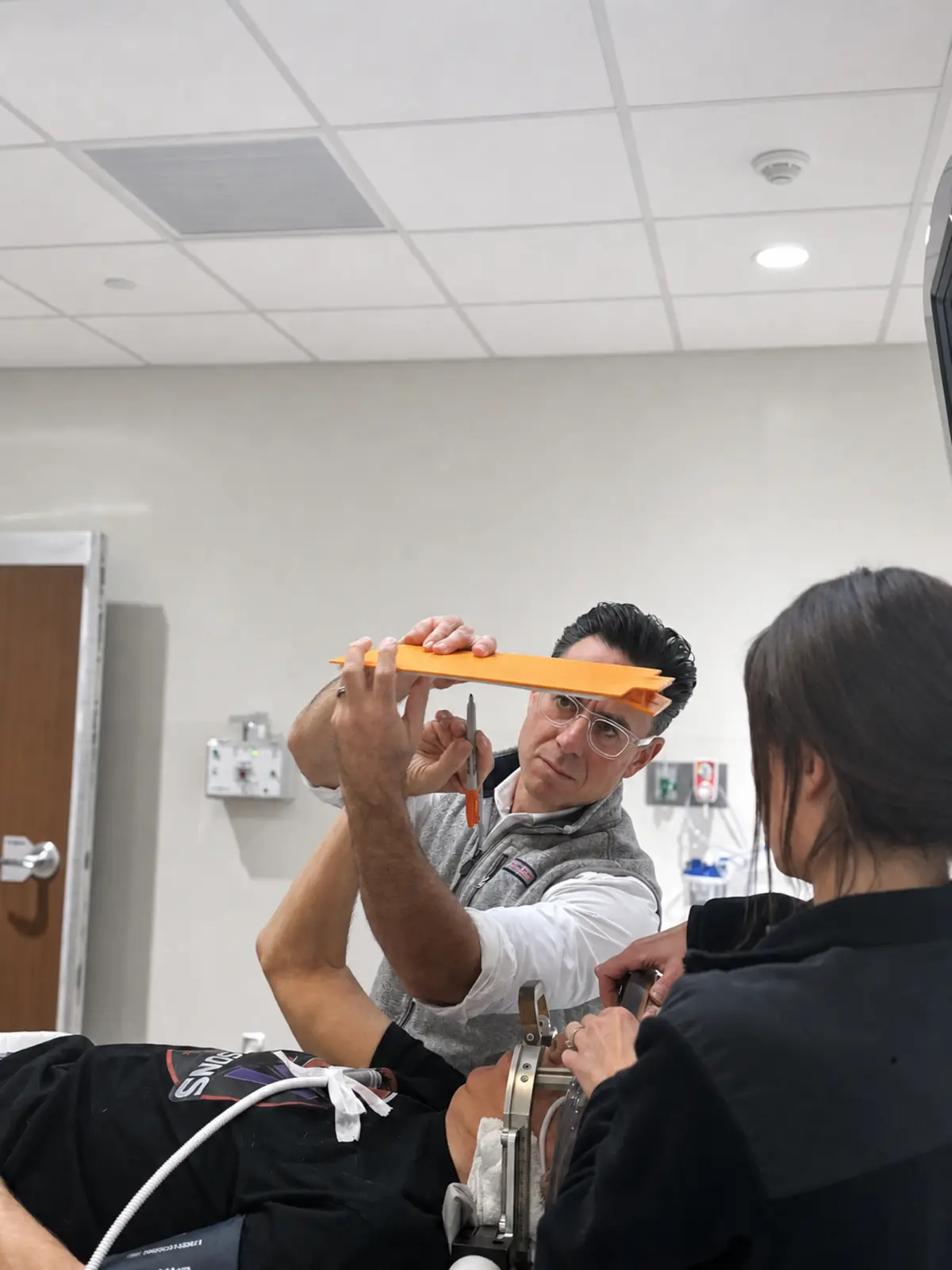
Most patients tolerate the procedure very well. The scalp is numbed before the stereotactic frame is placed. Patients may feel pressure from the frame, warmth during sonications, or mild discomfort from lying in the MRI scanner for several hours, but severe pain is uncommon.
No. Patients remain awake during focused ultrasound treatment. This allows the team to evaluate tremor improvement and monitor neurologic function throughout the procedure.
The scalp must be shaved completely so that the ultrasound helmet can make direct contact with the scalp. This allows the ultrasound energy to travel safely and efficiently through the skull.
Most patients go home the same day after a period of observation. Focused ultrasound is generally an outpatient procedure.
Recovery is usually much easier physically than patients expect. Fatigue, mild imbalance, tingling, or temporary gait difficulty can occur during the first days to weeks after treatment, but most patients recover steadily over time.
The most common temporary side effects include:
-
imbalance or unsteadiness,
-
numbness or tingling,
-
mild speech changes,
-
headache,
-
and temporary coordination difficulty.
Most improve gradually with time, though some symptoms can persist long-term in a minority of patients.
Yes. Because focused ultrasound creates a permanent lesion, some side effects may persist long-term. These risks are discussed carefully during the evaluation process and are one reason why patient selection and treatment precision are so important.
Yes, in selected patients. Focused ultrasound was initially performed only on one side of the brain, but staged bilateral treatment is now FDA-approved for carefully selected patients. Bilateral treatment can improve tremor in both hands but also carries increased risks of speech, balance, and coordination problems.
Focused ultrasound creates a permanent lesion without implanted hardware, while DBS uses adjustable electrical stimulation delivered through implanted electrodes. Focused ultrasound is incisionless and requires no programming, while DBS is adjustable and reversible. Each treatment has unique advantages and limitations.
Some patients are able to reduce tremor medications after successful treatment, while others continue medication depending on residual symptoms or the untreated side. Patients with Parkinson’s disease usually continue at least some Parkinson’s medications.
Studies have shown durable tremor improvement lasting years in many patients. However, focused ultrasound does not stop the underlying disease from progressing, so symptoms can evolve over time.
Yes. While many patients maintain substantial long-term improvement, tremor can gradually recur or progress over time because the underlying neurologic condition continues to evolve.
One of the major advantages of focused ultrasound is that there is no implanted hardware to maintain. There are no batteries, no charging systems, and no programming visits.
Yes. Because there is no implanted device requiring programming, much of the follow-up care can often be performed through telemedicine, which is especially convenient for patients traveling from outside the Chicago area.
The best candidates are patients with medication-refractory tremor whose symptoms match conditions known to respond well to focused ultrasound and whose imaging and skull characteristics are favorable for treatment.
The skull density ratio is a measurement obtained from a CT scan that helps determine how efficiently ultrasound energy will pass through the skull. Some skulls transmit energy more effectively than others, and this can influence candidacy and treatment efficiency.
In selected cases, yes. Prior DBS surgery does not automatically exclude focused ultrasound treatment, although each situation requires individualized evaluation.
If improvement is incomplete or symptoms evolve over time, additional treatment options—including DBS—may still be considered depending on the individual situation.
Focused ultrasound is highly dependent on accurate diagnosis, imaging interpretation, target selection, skull analysis, and procedural precision. Experienced multidisciplinary centers are better equipped to evaluate candidacy, minimize risk, and optimize outcomes.
The goal of focused ultrasound is meaningful improvement in function and quality of life—not perfection or cure. For the right patient, treatment can significantly reduce tremor and improve confidence, independence, and daily activities.